

Intel 5th-Gen Core vs. 10th-Gen Core Architecture Benchmarked
Intel fifth-gen vs. 10th-gen, but why? You would be forgiven if you had no idea Intel even had a 5th generation mainstream desktop processor range, because information technology consisted of simply two socketed parts, and neither of them were on sale for especially long, despite being Intel's most interesting CPUs in years.
Broadwell was kind of a big deal every bit it ushered in Intel's at present infamous 14nm process. Information technology was mid-2015 and the chipmaker's and so new and very cutting border 14nm process was a big deal, we simply didn't wait that they'd withal be relying on information technology six years afterward with their 11th-gen Core series processors.

The 14nm procedure also had its issues and was heavily delayed -- just not "10nm" heavily delayed -- simply it was, and every bit a result Broadwell arrived much after than expected, forcing Intel to refresh Haswell a yr after release, and it would still be another full year before 14nm Broadwell would arrive.
Only it'd be short lived. Incredibly, a mere two months afterwards the release of the Cadre i7-5775C and Cadre i5-5675C, both parts were essentially discontinued as Intel moved on with Skylake-S, pumping out a full range of 14nm Core i7, i5, i3, Pentium and even Celeron processors. Skylake almost transitioned to DDR4, while Broadwell parts were express to DDR3 on the Z97 platform.
| Core i7 5775C | Core i7 6700K | Core i7 8700K | Cadre i7 10700K | Cadre i7 11700K | |
|---|---|---|---|---|---|
| MSRP $US | $366 | $339 | $359 | $374 | $399 |
| Release Date | June 2022 | August 2022 | October 2022 | May 2022 | March 2022 |
| Cores / Threads | 4/8 | 6/12 | eight/sixteen | ||
| Base of operations Frequency | 3.xxx GHz | iv.00 GHz | 3.70 GHz | 3.80 GHz | 3.threescore GHz |
| Max Turbo | three.70 GHz | four.20 GHz | 4.seventy GHz | v.10 GHz | v.00 GHz |
| L3 Cache | 6 MB | eight MB | 12 MB | 16 MB | |
| Socket | LGA 1150 | LGA 1151 | LGA 1200 | ||
| TDP | 65 watts | 91 watts | 95 watts | 125 Westward | |
So in a fashion, Broadwell-DT was a failure, leaving the ultra expensive Broadwell-East parts to push button Intel HEDT agenda forrard. But it's my opinion that Broadwell-DT was much more than interesting than Broadwell-E, despite beingness limited to just 4 cores, while parts like the Core i7-6950X packed ten.
This is because Broadwell-DT featured what Intel called "Crystal Well" which was code for CPUs featuring eDRAM and equally introduced with Haswell, though only in BGA course. In the instance of the 5775C we got the offset socketed Crystal Well part and it received 128MB eDRAM, which acted like an L4 enshroud. The intention was to feed the iGPU a lot more than memory bandwidth, which would improve 3D graphics performance, only when not utilized by the iGPU it could exist used by the CPU, equally additional enshroud.

Nosotros reviewed the Core i7-5775C dorsum in 2022 and found that information technology was able to beat out AMD's best iGPU solutions in games, sometimes by up to a 60% margin, though it did price at to the lowest degree 3 times more. Actually, pricing was always going to be a big issue for any desktop CPU back in 2022 with an on-bundle 128MB retentiveness buffer and the 5775C came in at $366, a toll bespeak Intel was probable making a lot less margin on when compared to the $339 4770K from years prior.
Now, given all my contempo testing surrounding Intel's 10th-gen Core series, where nosotros compared different L3 enshroud capacities with everything else equal such every bit core count, core frequency, retentiveness frequency and timings, many asked if information technology'd exist possible to add the Core i7-5775C to the results.

I was hesitant at first because it's non exactly an apples to apples test, the 5775C uses slower DDR3 retention and clocking it upward to 4.5 GHz was going to be difficult. But given nosotros already had tested the Core i3-10105F at 4.2 GHz I idea if I could become the 5775C to the aforementioned frequency that would be a really interesting comparison.
Like the Core i3 model, the 5775C packs a 6MB L3 enshroud, though of course uses much older cores, just it also has the 128MB L4 enshroud and that will be fabricated available to the cores when using the Radeon RX 6900 XT. So simply how good was the 5775C, and can information technology stand to modern quad-cores similar the awkwardly named Core i3-10105F?
| Year of release | Microarchitecture | Tick or Tock | Process Node |
| 2019 | Comet Lake | Tock | 14nm |
| 2017 | Java Lake | Tock | 14nm |
| 2017 | Kaby Lake | Tock | 14nm |
| 2015 | Skylake | Tock | 14nm |
| 2015 | Broadwell | Tick | 14nm |
| 2013 | Haswell | Tock | 22nm |
| 2012 | Ivy Bridge | Tick | 22nm |
| 2011 | Sandy Span | Tock | 32nm |
| 2010 | Westmere | Tick | 32nm |
| 2008 | Nehalem | Tock | 45nm |
| 2007 | Penryn | Tick | 45nm |
| 2006 | Conroe | Tock | 65nm |
To find out, of course, nosotros ran a serial of benchmarks, merely earlier we become to that, a few additional test notes. Beginning, please be aware that the Cadre i3-10105F and Core i7-5775C ran at a slight clock speed disadvantage when compared to the i5, i7 and i9 parts. This is considering the highest stable frequency I could attain with the 5775C was 4.2 GHz and then 10105F is locked at a four.2 GHz all-cadre.
For the tenth-gen parts, we used the Gigabyte Z590 Aorus Xtreme motherboard. I then clocked the three 1000-SKU CPUs at iv.5 GHz with a 45x multiplier for the ring coach and used DDR4-3200 CL14 dual-rank, dual-aqueduct retentiveness with all primary, secondary and tertiary timings manually configured. The Cadre i3-10105F used the aforementioned spec memory, but I was unable to adjust the clock frequency.
The Cadre i7-5775C was tested on the Asus Z97-Pro motherboard using the latest BIOS and some DDR3-2400 CL11-13-thirteen-31 memory. We used an RX 6900 XT for testing every bit information technology'southward the fastest 1080p gaming GPU around. Let's check out the results.
Benchmarks
Starting with Rainbow Six Siege, the two results we want to focus on here are those of the Core i3-10105F and Core i7-5775C. The old fifth-gen Core i7 using DDR3-2400 memory pushed the 6900 XT to 325 fps on average, which is an impressive event when you lot consider that the 10105F was simply x% faster and information technology enjoys the benefit of much faster DDR4-3200 memory, along with numerous generations of core and architecture refinement.

What this means is, when matched with the same cadre count and operating frequency, we're looking at what is effectively just a x% IPC improvement for Intel over a 6 year menstruation, when using Rainbow Half dozen Siege as the measuring stick. That'southward a shockingly modest improvement given this likewise includes an upgrade in memory technology.
Of course, Intel has added more cores and cache since then, but if we stick with the iv core configurations we see that the 10600K is 22% faster, the 10700K 31% faster and the 37% faster, and of course those margins widen further one time you enabled all supported cores for those parts.
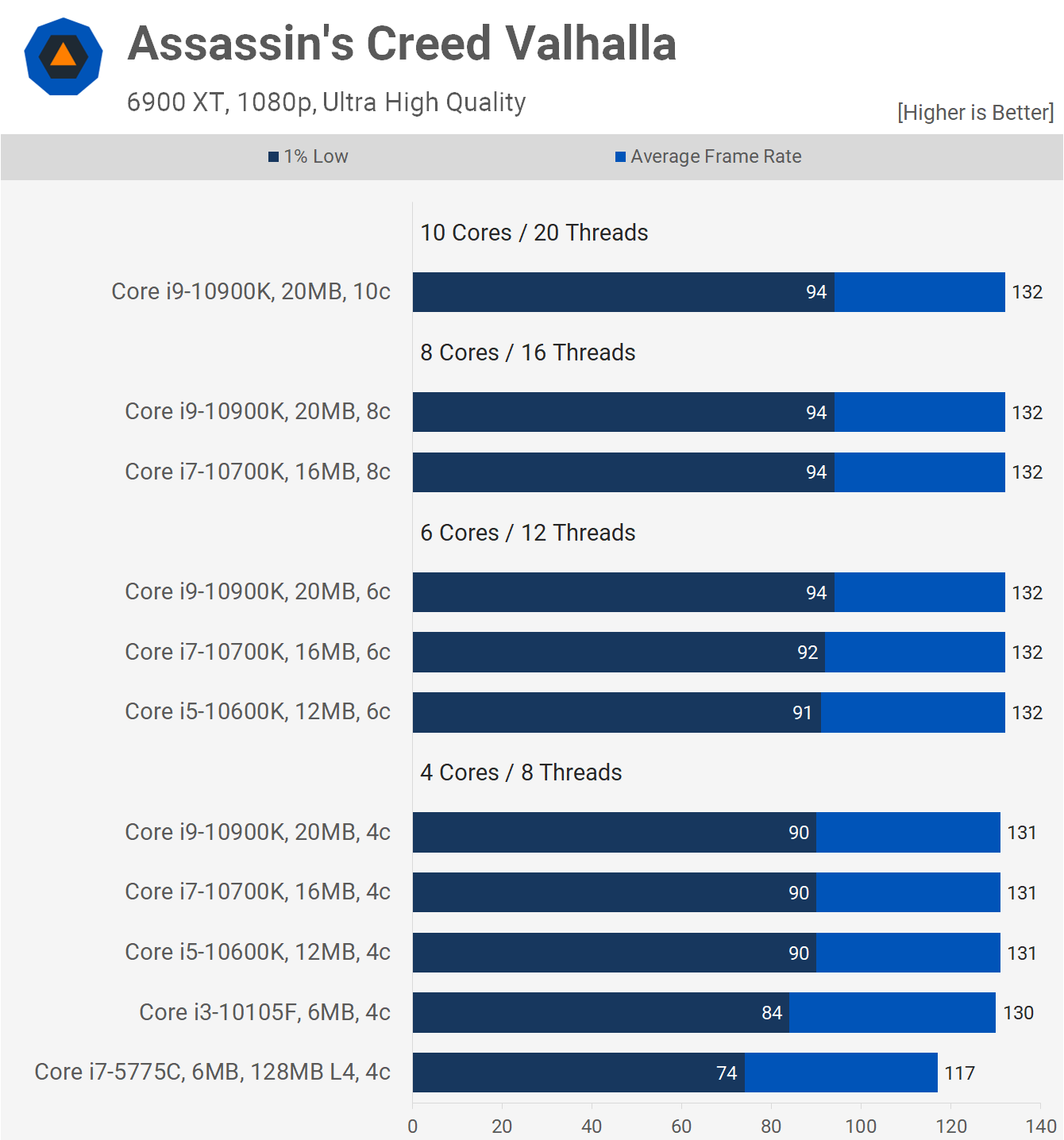
The Assassinator's Creed Valhalla data isn't terribly useful as the 10th-gen parts are all heavily GPU limited and this wasn't the example for the 5775C which trailed the average frame charge per unit consequence of the 10th-gen Cadre i3 by 10% and the 1% low by 12%. So information technology's difficult to brand whatsoever existent performance claims based on this data, so let'southward move on.

The Battlefield V results are interesting equally the 5775C wasn't a great bargain slower than the 10105F, especially when looking at the 1% depression data. When comparison the boilerplate frame charge per unit the 5th-gen function was simply 3% slower, but we saw a much larger 17% drop in performance for the i% low, and I'd say this is largely down to the departure in memory and cache bandwidth. Something we'll look at a footling later on.
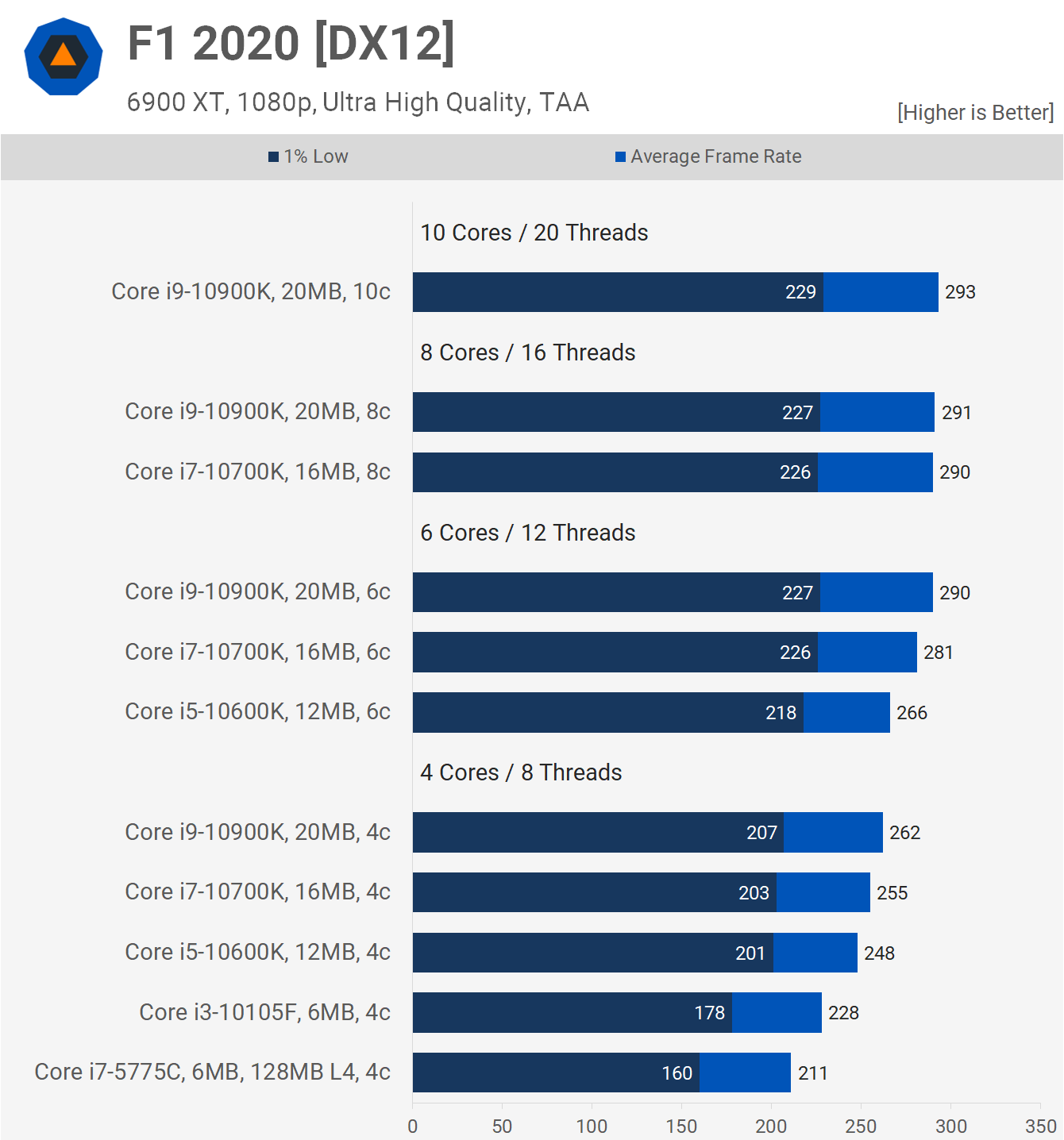
Moving on to F1 2022, the 10th-gen Core i3 actually isn't offering much in the way of extra performance over the aging 5th-gen 5775C. We're looking at an viii% improvement in average frame charge per unit with an 11% boost to the 1% depression performance. Here Intel's accomplished it'due south biggest performance gains over the years simply past calculation more L3 cache, as seen with the 10600K. It's only a 13% operation uplift, merely that's significant given the 10105F and 10600K are based on the verbal same CPU architecture.

Hitman shows very piddling progress for Intel over the past 6 years. The tenth-gen Cadre i3 was simply v% faster than the 5775C and again it's the doubling of L3 cache that'south atomic number 82 to the biggest performance comeback every bit the 10600K offered a 9% boost from the 10105F and an 11% increase in 1% low performance.

Next we have Horizon Zero Dawn, and I suspect retentivity bandwidth is at a premium here as the 10th-gen Core i3 was up to 12% faster and 14% faster when comparing the i% depression data. This is one of the bigger performance uplifts we've seen for tenth-gen over 5th-gen.
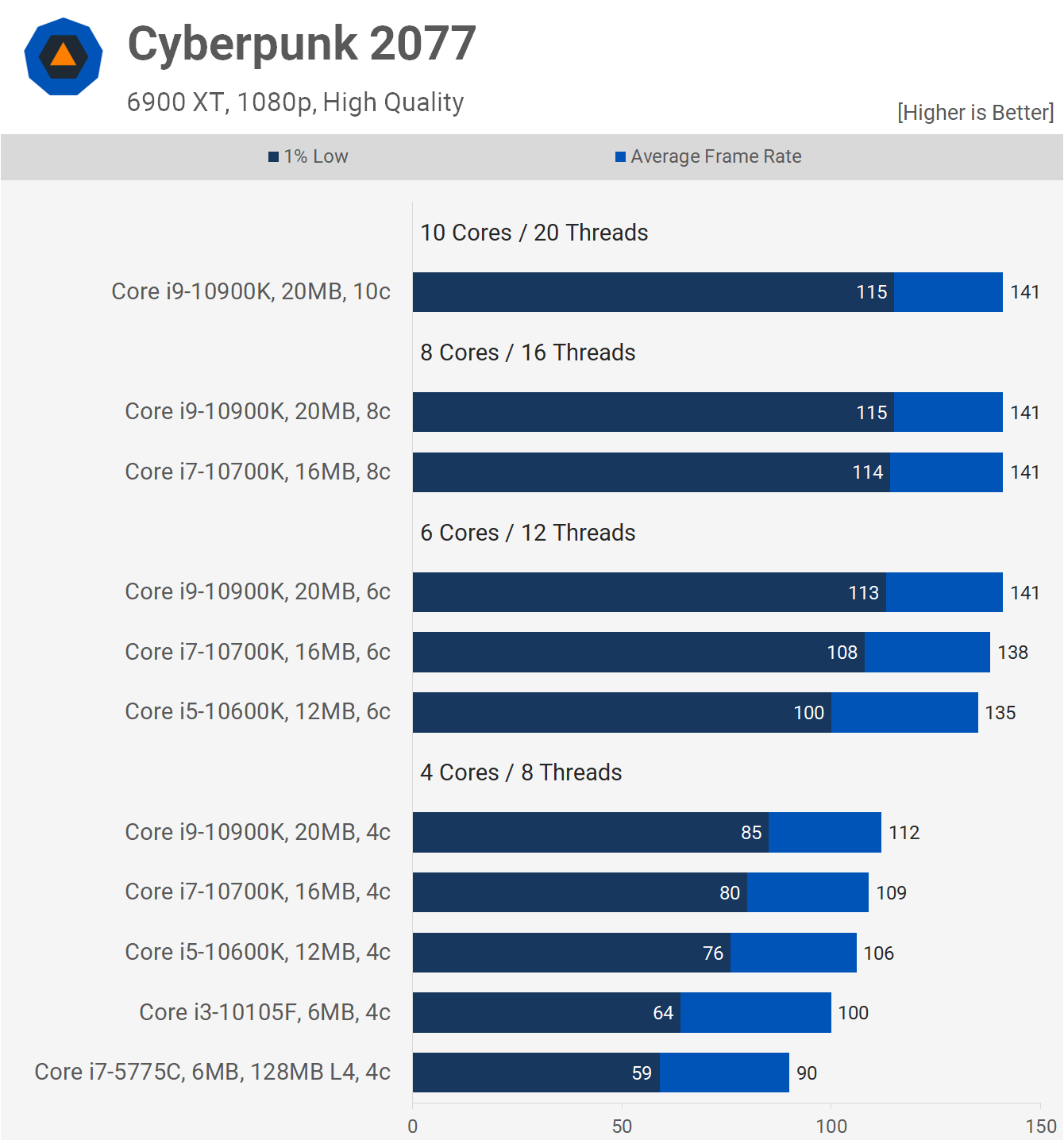
Nosotros're besides looking at an 11% increase in performance for the 10105F over the 5775C. Then if we take what would be Intel fastest quad-core, the 20MB 10900K with just four cores active, we see that information technology's 24% faster than the 5775C, and then a decent functioning uplift in that location, only probably a lot less than what yous'd wait to come across later on more than than one-half a decade.

Shadow of the Tomb Raider has always been crude on quad cores, even those with 8 threads, and this is especially in the village section that we use for testing. That said, with powerful enough cores the experience tin can be quite skillful, as seen with the 4-core 10600K, 10700K and 10900K configurations. Then if nosotros look at the 10105F nosotros run into a 16% drop in 1% depression operation from the 10600K, while the 5775C is a further 12% slower again.
So if we hone in on the 5775C and 10105F comparison nosotros run across that over the last six years Intel has improved performance by up to 14%, seen when looking at the i% depression data. Not amazing, but it's certainly ameliorate than near other results we've seen and then far.

The last game we're going to look at is Spotter Dogs Legion and here the 10105F was 11% faster than the 5775C for the average frame rate, and 17% faster when looking a the 1% depression data. Then once again non a huge or even significant performance increment for what amounts to vi generations of progress.
Cache Bandwidth
Before wrapping up the testing here'southward a look at cache bandwidth. Likewise please note that all tenth-gen configurations enjoyed a memory bandwidth of 38 GB/s. That'southward 38 GB/south for the DDR4-3200 retentivity when measured using the SiSoftware Sandra 2022 retention bandwidth test, so not AIDA64 which will give you higher readouts.

I oasis't bothered with a memory bandwidth graph considering the eleven tested configurations gave just two dissimilar results. Once again, for the tenth-gen parts it's 38 GB and that'south regardless of model or core count. The Cadre i7-5775C on the other hand was limited to thirty GB/southward using the DDR3-2400 memory. That means the newer 10th-gen CPUs enjoyed 27% increase in memory bandwidth, so quite a substantial advantage there.
At present, when looking at enshroud bandwidth there are a few interesting things to notation. First, L1 and L2 is a per-core cache, so the bandwidth figure is effectively multiplied by core count, so we get our best comparison with 4 cores agile and here all 10th-gen models are much the same. What nosotros can see is that Intel managed to improve L1 cache bandwidth by 11% from the fifth-gen architecture to the 10th, and and so the L2 cache bandwidth by a much more substantial 55%.
Then nosotros run into a 33% comeback in L3 cache bandwidth when comparing the 5775C and 10105F. And so although the chapters is the same, the bandwidth has been radically improved.
Finally we see that while useful, the eDRAM L4 cache bandwidth isn't huge and in fact it's not much greater than the tenth-gen models accessing arrangement memory with a bandwidth of just 39 GB, around 4x slower than the L3 cache of the 10105F. That probably explains why back in 2022 I found the 5775C was only around x% faster than the 4770K when compared clock-for-clock in a range of awarding benchmarks.
Wrap Up
Obviously, beingness stuck on their 14nm procedure for what seems like an infinite corporeality of pluses, Intel'due south progress over the years has been slower than expected. In a way, it'due south impressive to see just how much they've been able to squeeze out of the 14nm process, while on the other paw, y'all'd normally expect to see significantly more progress six years later.
If you'd had told me back in 2022 that past the yr 2022 Intel's latest and greatest CPUs would be around 10% faster in games at the same core count and clock speed, I doubtfulness I would have believed you lot. More so considering that at the time I'd be using a GeForce GTX 980 Ti for benchmarking, whereas today'due south 6900 XT is nearly 3x faster.

Furthermore, if you had also told me that AMD would exist dominating Intel on mainstream and loftier-end desktop platforms, also as the server market by 2022, I would accept passed out from laughter, and then definitely don't heed to my long term predictions. Not that I make them, just if I do ALT+F4.
At present to exist fair, Intel'southward taken some expert steps forward since the fifth-gen Core i7 by adding more cores and while that has seen ability usage skyrocket, and so too has performance (and the price). Certainly non as much every bit Intel would have liked, only the 10900K and/or 11900K are much much faster than the 5775C, they're likewise much bigger dies, peculiarly the 11900K, merely as nosotros've noted numerous times, that'southward because they all apply the aforementioned 14nm process, or at least a variation of it.

Then, that's how the Cadre i7-5775C compares against more than modernistic 10th-gen models and we've gotta say it's held up really well, especially when looking in a 4-core bubble. That L4 cache is not well-nigh as handy as you'd recollect, at least not for CPU functioning, though information technology'southward certainly very handy for GPU performance which would otherwise be heavily limited past the bandwidth of the PCI Limited 3.0 motorcoach.
And that's going to exercise it for this strange await back at the Core i7-5775C. Hope you enjoyed this "for science" hardware feature. We'll come dorsum for more.
Shopping Shortcuts:
- Intel Core i5-11600K on Amazon
- AMD Ryzen 5 5600X on Amazon
- Intel Cadre i7-11700 on Amazon
- AMD Ryzen seven 5800X on Amazon
- AMD Ryzen 9 5950X on Amazon
- GeForce RTX 3060 Ti on Amazon
- GeForce RTX 3070 Ti on Amazon
- Radeon RX 6600 XT on Amazon

Source: https://www.techspot.com/review/2331-intel-5th-gen-vs-10th-gen/
Posted by: andersonnotted.blogspot.com
0 Response to "Intel 5th-Gen Core vs. 10th-Gen Core Architecture Benchmarked"
Post a Comment